
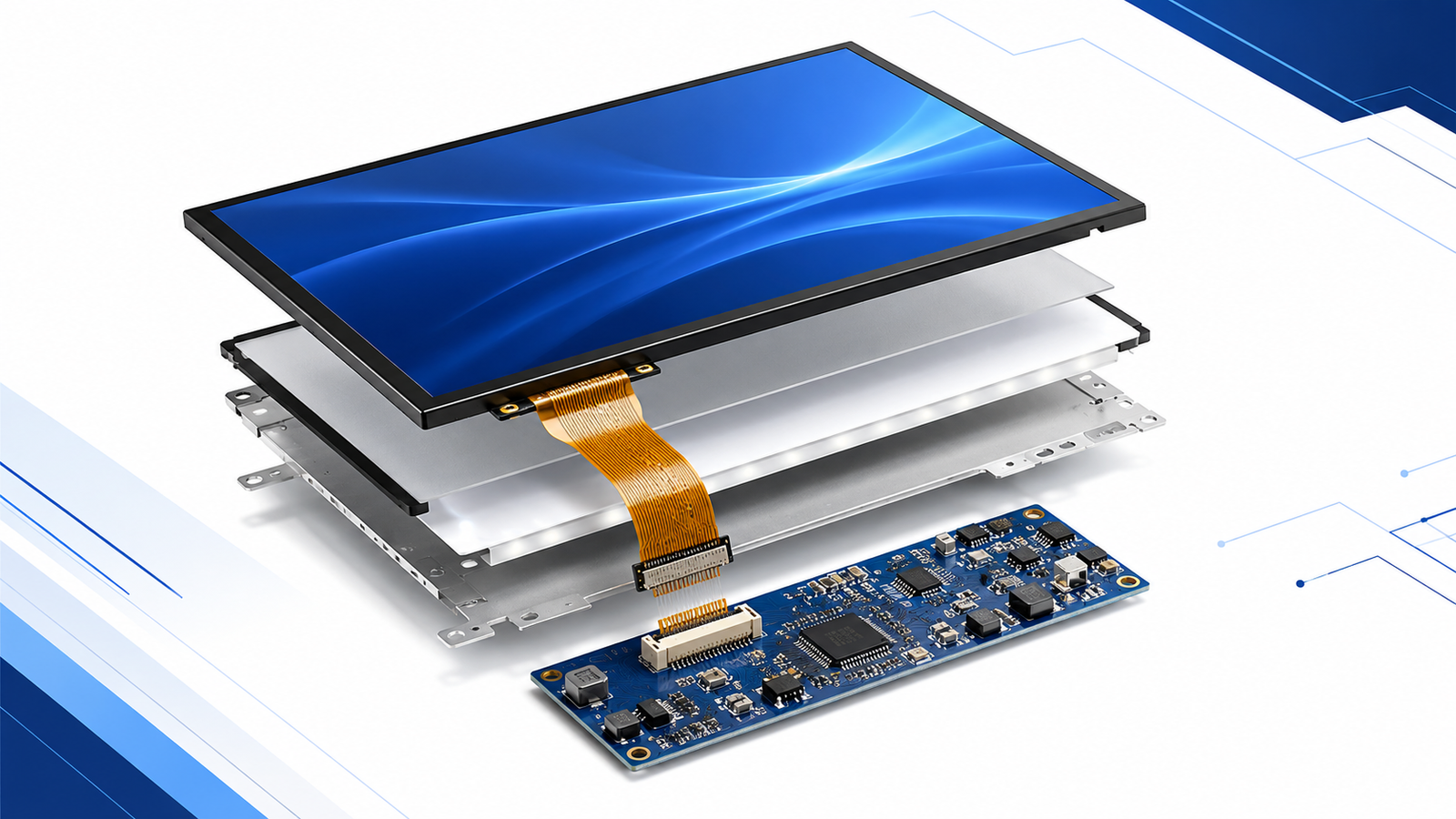
A TFT LCD module is a complete display component built around a thin-film transistor liquid crystal display. It is commonly used in embedded products, industrial equipment, smart devices, medical instruments, control panels, handheld terminals, and HMI systems. Compared with a bare LCD panel, a TFT LCD module usually includes the display panel, backlight, driver circuit, FPC connector, and sometimes a touch panel or additional mechanical structure.
For hardware engineers and product teams, the important question is not only “What is a TFT LCD module?” but also “How do I choose one that fits my product architecture, user environment, production plan, and long-term supply requirements?” A display module affects electrical design, mechanical structure, firmware development, enclosure design, user experience, and procurement planning. Choosing the wrong module can increase integration risk, delay prototype validation, or create avoidable redesign work later.
What Does a TFT LCD Module Mean?
TFT stands for thin-film transistor. In a TFT LCD, each pixel is controlled by one or more thin-film transistors, allowing the display to show full-color images with better response, contrast, and image control than older passive matrix LCD technologies. LCD stands for liquid crystal display, which means the display uses liquid crystal material to control how light passes through the panel.
A TFT LCD module is more than the glass panel itself. In practical product development, the “module” usually refers to a display assembly that can be integrated into an electronic device. Depending on the design, it may include the TFT LCD panel, backlight, driver IC, flexible printed circuit, connector, touch panel, cover lens, and other supporting parts.
This modular structure makes TFT LCD modules easier to integrate into embedded systems than a bare display panel. The module supplier has already combined key display elements into a usable assembly, while the device manufacturer can focus on matching the module with the control board, firmware, enclosure, power design, and application software.
What Components Are Usually Included in a TFT LCD Module?
The exact structure depends on the module design, but most TFT LCD modules include several core elements.
TFT LCD Panel
The TFT LCD panel is the visual display layer. It contains the pixel matrix that forms images, icons, numbers, menus, and graphical user interfaces. Important panel-related parameters usually include size, resolution, aspect ratio, viewing direction, viewing angle, contrast, and display mode. These details should be confirmed from the supplier’s datasheet before design-in.
Backlight Unit
Most TFT LCD modules require a backlight because the liquid crystal layer does not emit light by itself. The backlight provides illumination from behind the panel. Brightness requirements vary depending on the application. Indoor control panels may need a different brightness level than outdoor devices, vehicle-mounted terminals, or industrial equipment used under strong ambient light.
Backlight design can also affect power consumption, thermal behavior, and user readability. For battery-powered devices, brightness should be balanced against energy use. For industrial or commercial equipment, readability and reliability may be more important than minimum power consumption.
Driver IC and FPC
A TFT LCD module typically includes a driver IC that controls display signals and pixel behavior. The FPC, or flexible printed circuit, connects the module to the main board or display control board. The connector position, pitch, pin assignment, and signal interface must match the system design.
This is one of the main reasons display selection should happen early in the product development process. A display module is not just a visual component; it affects PCB layout, control board selection, firmware development, and enclosure structure.
Touch Panel Option
Many TFT LCD modules can be supplied with a touch panel. The two most common options are capacitive touch and resistive touch.
Capacitive touch is widely used in modern smart devices and HMI systems because it supports a smooth user experience and can often support multi-touch operation, depending on the controller and system design. Resistive touch can be useful in certain industrial environments where gloves, styluses, or pressure-based input are required.
The right touch type depends on the target user, operating environment, cost target, enclosure design, and control system.
Mechanical and Connector Structure
A TFT LCD module also has physical design constraints. Engineers need to consider active area, outline dimension, thickness, mounting method, FPC direction, connector type, cover lens design, and enclosure clearance. Even when the electrical interface is suitable, the module may still require mechanical adjustment if the product has limited internal space or a special front-panel design.
How Does a TFT LCD Module Work?
A TFT LCD module works by controlling light transmission through liquid crystal cells. The backlight emits light from behind the display. The liquid crystal layer changes the amount of light passing through each pixel, while color filters help generate red, green, and blue subpixels. Thin-film transistors control these pixels so that the display can show images, text, icons, and graphical interfaces.
The host processor or display control board sends image data to the module through an interface such as RGB, MIPI, LVDS, SPI, or another supported signal format. The driver IC processes the display signals and controls the pixel matrix. If a touch panel is included, the touch controller sends input data back to the host system.
In a finished product, the display module is part of a larger system. It must work with the main board, operating system or firmware, application UI, power design, enclosure, and user environment. That is why module selection should not be treated as a last-minute purchasing decision.
TFT LCD Module vs LCD Panel: What Is the Difference?
A TFT LCD panel is usually the core display glass and pixel structure. A TFT LCD module is a more complete assembly that includes additional components needed for integration.
| Item | TFT LCD Panel | TFT LCD Module |
|---|---|---|
| Main meaning | Core display panel | Integrated display assembly |
| Typical included parts | Display glass and pixel structure | Panel, backlight, driver IC, FPC, connector, and sometimes touch |
| Ease of integration | Requires more engineering support | Easier to integrate into embedded systems |
| Buyer focus | Panel-level technical fit | Product-level display solution |
| Common use case | Internal display manufacturing or advanced integration | OEM devices, industrial products, HMI systems, smart equipment |
For most OEM projects, engineers and buyers are usually looking for a TFT LCD module rather than only a bare panel. The module format reduces integration complexity and gives the product team a clearer path from prototype to production.
Common TFT LCD Module Interface Options
Interface selection is one of the most important decisions when choosing a TFT LCD module. The interface must match the processor, MCU, display controller, board layout, image performance requirements, and software environment.
| Interface | Common Use Case | Buyer Consideration |
|---|---|---|
| RGB | Embedded systems, MCU/MPU-based products | Requires more signal lines and careful PCB layout |
| MIPI | Modern smart devices and compact embedded products | Useful for higher integration and reduced pin count, but requires compatible host support |
| LVDS | Larger displays and industrial applications | Often used when longer signal routing or higher display data rates are needed |
| SPI | Small displays and simple interfaces | Lower pin count, but usually not suitable for high-resolution or high-refresh display needs |
| HDMI | Display systems using standard video output | Often used with control boards rather than directly with small embedded modules |
| eDP | Higher-performance embedded display systems | Requires compatible processor or display control architecture |
The interface should not be selected only based on availability. It should be evaluated together with resolution, refresh needs, EMI considerations, board space, firmware support, and the chosen control platform.
Where Are TFT LCD Modules Used?
TFT LCD modules are widely used because they provide a practical balance of color display performance, integration flexibility, and availability across many sizes and formats.
Common application areas include industrial control panels, smart home products, medical devices, commercial equipment, handheld terminals, automotive accessories, testing instruments, charging equipment, payment terminals, kitchen appliances, fitness equipment, and embedded HMI systems.
For example, a compact device may use a small TFT LCD module with touch input for simple control and status display. A commercial machine may use a larger TFT LCD module as part of an HMI system. An industrial product may require a display with suitable brightness, operating temperature, mounting structure, and long-term supply support.
In each case, the module must match both technical requirements and product lifecycle needs.
How to Choose the Right TFT LCD Module
Choosing a TFT LCD module should start with the product requirement, not only with display size. A good selection process considers electrical, optical, mechanical, software, commercial, and lifecycle factors.
Size and Resolution
Display size affects user experience, enclosure design, cost, and power consumption. Resolution affects UI clarity and the amount of information that can be displayed. Higher resolution is not always better if the control board, interface, or software cannot support it efficiently.
Before selecting a module, define the information that users need to see, the viewing distance, the UI complexity, and the available front-panel space.
Interface Compatibility
The display interface must be compatible with the main control board or processor. If the product already uses a specific MCU, MPU, or Android control board, the display interface options may be limited. Engineers should confirm supported interfaces early, including signal voltage, pin definition, connector type, driver support, and software compatibility.
For display-computing integration projects, a module may need to be selected together with a control board. For example, if an HMI system requires Android software, network connectivity, multimedia capability, and touch control, the TFT LCD module and control board should be evaluated as one system rather than separate parts.
Brightness and Viewing Environment
Brightness should match the operating environment. A display used indoors does not have the same requirement as a display used near windows, outdoors, or under strong industrial lighting. Buyers should also consider viewing angle, contrast, surface treatment, and cover lens design.
For outdoor or high-ambient-light applications, the display may require higher brightness, optical bonding, anti-glare treatment, or other design adjustments. Exact requirements should be confirmed based on the product environment.
Touch Requirements
If the device needs user input, the touch solution should be selected with the display module. Capacitive touch is common for modern graphical interfaces, while resistive touch may still be relevant in some industrial or specialized applications. The decision should account for gloves, moisture, stylus use, cover lens thickness, EMC requirements, and the expected user behavior.
Mechanical Design and Mounting
Mechanical fit is a frequent source of integration problems. The display outline, active area, bezel design, FPC direction, connector position, thickness, mounting frame, and enclosure clearance must all be checked. A small mismatch can cause expensive redesign later.
Product teams should review 2D drawings, 3D structure files if available, and prototype samples before locking the enclosure design.
Lifecycle and Supply Stability
For B2B products, display availability matters. A display module used in industrial equipment, commercial devices, or medical instruments may need to remain available for years. Buyers should discuss lifecycle support, alternative options, customization risks, and future replacement planning with the supplier.
Supply stability is not only a procurement issue. It affects maintenance, product revisions, certification planning, and customer support.
Can TFT LCD Modules Be Customized?
Yes, TFT LCD modules can often be customized, depending on the project requirement and supplier capability. Common customization areas may include cover lens design, touch panel integration, backlight brightness, FPC design, connector type, interface adaptation, mechanical structure, surface treatment, and display-control integration.
Customization is useful when a standard module does not fully match the product’s industrial design, enclosure, user environment, or system architecture. It can also help reduce development risk when the supplier supports both display module selection and integration with control boards or HMI systems.
However, customization should be planned carefully. It may affect tooling, sample validation, lead time, certification work, and long-term procurement. For this reason, OEM teams should define technical requirements clearly before requesting a custom module.
What Project Information Should You Prepare Before Requesting a Quote?
A clear RFQ helps the supplier recommend the right TFT LCD module and avoid unnecessary back-and-forth. Before contacting a display supplier, prepare the following information where possible:
| RFQ Information | Why It Matters |
|---|---|
| Display size | Determines module category and mechanical fit |
| Resolution | Affects UI clarity, interface choice, and control board requirements |
| Interface | Must match the host processor or control board |
| Touch type | Impacts user input, cover lens, and controller selection |
| Brightness | Must fit indoor, outdoor, or industrial lighting conditions |
| Operating environment | Influences temperature, durability, surface treatment, and readability |
| Target application | Helps the supplier understand use case and risk factors |
| Annual volume | Supports supply planning and commercial evaluation |
| Prototype quantity | Helps plan sample support and validation |
| Project timeline | Important for development schedule and production planning |
| Customization requirements | Affects engineering review and feasibility |
| Software or firmware needs | Relevant for HMI and control board integration |
| Enclosure or mechanical requirements | Helps avoid fit and mounting problems |
The more complete the information, the easier it is to identify whether a standard TFT LCD module is enough or whether a custom display solution is required.
Work with RJY on TFT LCD Module Selection
RJY supports TFT LCD module selection and display-related integration for embedded products, smart devices, industrial equipment, and HMI systems. For projects that require more than a standard display, RJY can help evaluate display size, interface, touch method, brightness, mechanical structure, and control board compatibility.
If your project involves display and computing integration, you may also need to evaluate an embedded control board together with the display module. For Android-based HMI systems, RJY’s RK3566 Android control board can be considered as part of the wider display-control architecture.
For products that require special shapes or non-standard interfaces, RJY also provides display options such as round LCD displays and bar-type LCD displays for embedded user interfaces. Relevant product pages include the 8-inch round LCD display, 7-inch round TFT LCD display, 2.8-inch round TFT LCD display, and 11.65-inch bar LCD display.
Conclusion
A TFT LCD module is a practical display assembly that combines a TFT LCD panel with supporting components such as a backlight, driver IC, FPC, connector, and optional touch panel. It is widely used in embedded systems, industrial equipment, commercial devices, smart products, and HMI systems.
For B2B projects, the right module is not only about screen size. Engineers and buyers should evaluate interface compatibility, brightness, touch requirements, mechanical fit, environmental conditions, customization needs, and lifecycle support. A well-selected TFT LCD module can simplify integration, reduce development risk, and support a smoother path from prototype to production.
FAQ
What is a TFT LCD module?
A TFT LCD module is a display assembly based on thin-film transistor liquid crystal display technology. It usually includes the TFT LCD panel, backlight, driver IC, FPC, connector, and sometimes a touch panel or cover lens.
What is the difference between a TFT LCD module and an LCD panel?
An LCD panel is mainly the core display glass and pixel structure, while a TFT LCD module is a more complete assembly designed for integration into electronic products. A module usually includes supporting components such as the backlight, driver circuit, FPC, and connector.
Can a TFT LCD module include a touch screen?
Yes. Many TFT LCD modules can be supplied with capacitive or resistive touch panels. Capacitive touch is common for modern smart interfaces, while resistive touch may still be useful in certain industrial or pressure-input applications.
Which interface is used for TFT LCD modules?
Common TFT LCD module interfaces include RGB, MIPI, LVDS, SPI, HDMI, and eDP. The right interface depends on the display size, resolution, host processor, control board, PCB layout, software support, and system architecture.
How do I choose a TFT LCD module for an embedded product?
Start with the application requirements. Confirm display size, resolution, brightness, interface, touch type, operating environment, mechanical structure, and lifecycle needs. The module should match both the electronic design and the physical product structure.
Can TFT LCD modules be customized for OEM projects?
Yes. Customization may include touch panel integration, cover lens design, backlight brightness, FPC design, connector type, interface adaptation, and mechanical structure. Exact customization feasibility should be confirmed based on project requirements.