
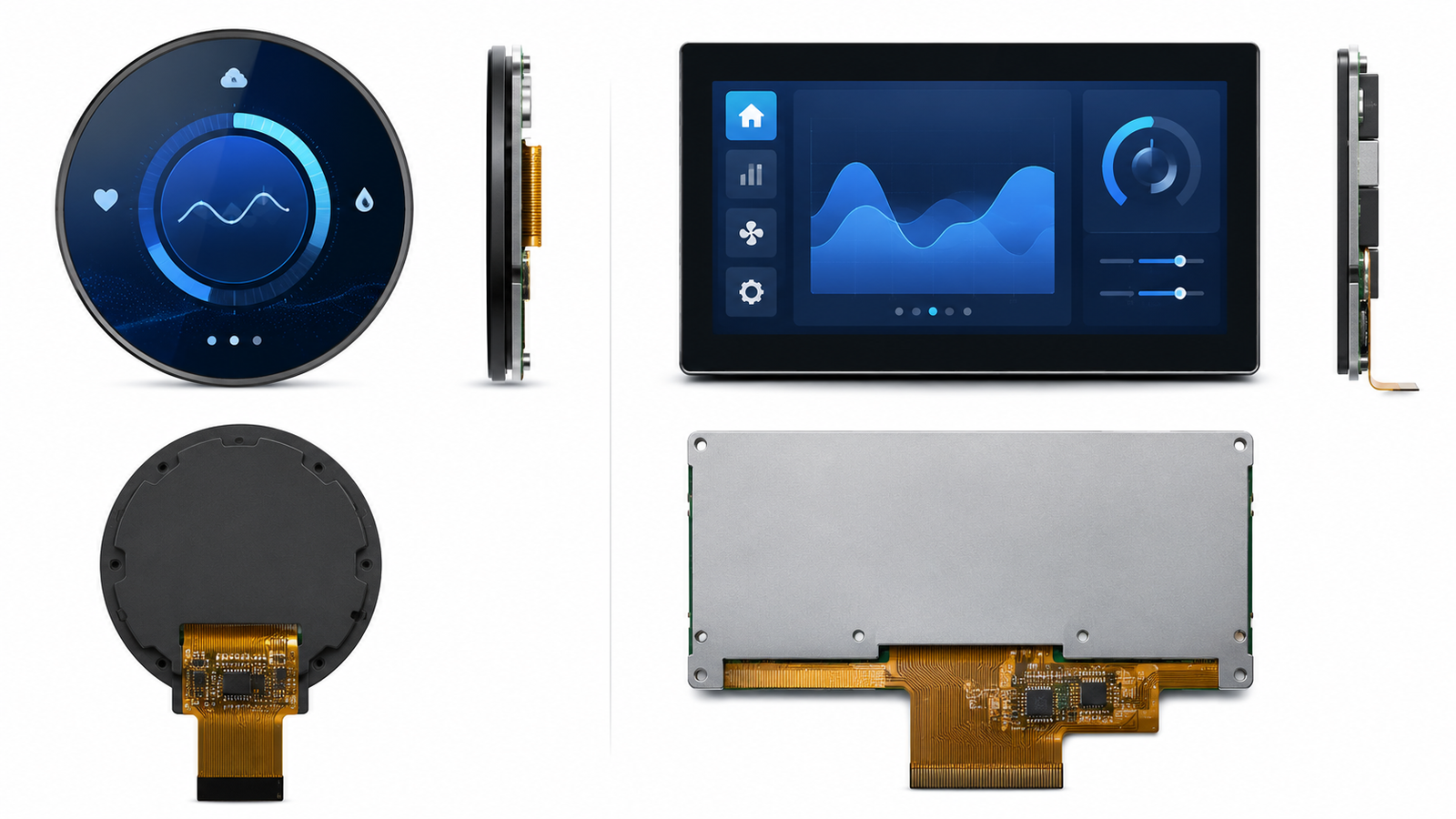
A round TFT LCD is a circular display module based on thin-film transistor liquid crystal display technology. Unlike a standard rectangular TFT LCD, a round TFT LCD is designed with a circular active display area, making it suitable for smart interfaces, control knobs, dashboards, wearables, home appliances, industrial HMI panels, and other products where a circular visual design is required.
For OEM product teams, a round TFT LCD is not only a different screen shape. It affects the user interface, enclosure structure, touch panel design, FPC routing, cover lens, display driver compatibility, and final product appearance. A circular display can make a product look more refined and distinctive, but it also requires careful engineering review before design-in.
This article explains what a round TFT LCD is, how it differs from standard displays, where it is used, and what engineers and buyers should consider before selecting one.
What Does a Round TFT LCD Mean?
TFT stands for thin-film transistor, and LCD stands for liquid crystal display. In a TFT LCD, each pixel is controlled by thin-film transistor technology, allowing the display to show full-color graphics, icons, menus, and user interface elements.
A round TFT LCD uses the same basic display principle as other TFT LCDs, but the visible display area is circular. The module may include the circular TFT LCD panel, backlight, driver IC, FPC connector, touch panel, cover lens, and mechanical support structure.
In practical product development, buyers usually look for a round TFT LCD module rather than only a bare display panel. A module is easier to integrate because it includes more of the components needed for electrical and mechanical connection.
How a Round TFT LCD Is Different from a Rectangular TFT LCD
The most obvious difference is shape, but the design impact goes deeper. A rectangular TFT LCD naturally fits many traditional user interfaces, such as menus, lists, images, graphs, and text blocks. A round TFT LCD requires a different UI layout because the display corners are not available.
This means the software interface should be designed for a circular viewing area from the beginning. Important information should be placed inside the usable circular area. Buttons, icons, gauges, and status indicators need to be arranged in a way that feels natural on a round display.
The enclosure design is also different. A round TFT LCD is often used when the product front panel, control area, dashboard, or smart device housing has a circular shape. The display, cover lens, touch panel, and mechanical frame should be considered together.
Key Components of a Round TFT LCD Module
A round TFT LCD module usually combines several components into one display assembly. The exact structure depends on the model and customization requirements.
Circular TFT LCD Panel
The panel is the main visual display component. It determines the active area, resolution, display mode, viewing angle, and image quality. For round displays, the relationship between active area and product front design is especially important. Engineers should confirm whether the visible circular area matches the UI and enclosure design.
Backlight and Optical Structure
Most TFT LCDs need a backlight because LCD technology does not emit light by itself. The backlight affects brightness, readability, power consumption, and thermal behavior. For smart home devices or indoor control panels, moderate brightness may be enough. For equipment used in stronger ambient light, brightness and optical design should be reviewed more carefully.
FPC and Interface Design
The FPC connects the round TFT LCD module to the control board. Its position, length, bending direction, connector type, and pin assignment can affect PCB layout and enclosure design. Interface options may vary by module and should be confirmed from the supplier’s datasheet.
Common display interfaces may include RGB, MIPI, SPI, LVDS, or other options depending on the size, resolution, and control architecture. The interface should be matched with the host processor or display control board early in the design process.
Touch Panel and Cover Lens
Many round TFT LCDs can be integrated with a touch panel. Capacitive touch is common in modern smart interfaces, while resistive touch may still be relevant for certain industrial or specialized applications.
The cover lens can improve appearance and durability, but it also affects mechanical thickness, optical performance, bonding method, and cost. For a circular display, the cover lens shape, edge treatment, printing area, and alignment must be carefully controlled.
Mechanical Structure
A round TFT LCD often needs closer coordination between the display supplier, mechanical engineer, and industrial designer. Outline dimensions, active area, thickness, mounting method, FPC outlet, and front cover design should all be checked before tooling or enclosure lock-in.
A small mismatch can cause assembly difficulty, light leakage, touch alignment issues, or redesign work.
Common Applications of Round TFT LCD Displays
Round TFT LCD displays are commonly used when the product design benefits from a circular user interface or compact visual control area.
| Application | Why Round TFT LCD Fits |
|---|---|
| Smart home control panels | Circular UI can support modern appliance and control designs |
| Industrial HMI knobs | Useful for compact parameter control and status display |
| Dashboards and meters | Circular layouts match gauges, dials, and indicators |
| Wearable devices | Round displays match watch-like product structures |
| Medical and beauty equipment | Supports compact, clean, and modern interface design |
| Commercial equipment | Helps create a differentiated front-panel design |
| Audio and control devices | Works well for rotary controls and visual feedback |
| Smart appliances | Suitable for circular menu, timer, and status interfaces |
The strongest reason to use a round TFT LCD is usually a combination of visual design and functional UI. If the product already uses circular interaction, such as a dial, knob, gauge, or control ring, a round display can make the interface more intuitive.
Why OEM Products Use Round TFT LCDs
OEMs often choose round TFT LCDs when they want the display to support both product function and industrial design. A circular screen can make a device look less generic than a standard rectangular display. It can also help the display fit into limited front-panel space or match a round mechanical control structure.
For smart devices, a round display can create a more consumer-friendly interface. For industrial products, it can be useful for compact status visualization, parameter adjustment, or dashboard-style monitoring. For HMI systems, it can support special interface concepts where a rectangular screen would not fit the product design.
However, a round TFT LCD should be selected for a clear design reason. If the application requires large text blocks, wide tables, complex menus, or video content, a rectangular display may be more practical.
Technical Factors to Consider Before Choosing a Round TFT LCD
The first factor is display size. A small round TFT LCD may be suitable for control knobs, compact smart devices, and handheld products. A larger round TFT LCD may be used in dashboards, smart panels, or industrial HMI systems. The size should match the viewing distance, UI complexity, and available mechanical space.
Resolution should be selected based on UI needs. A higher resolution may improve visual detail, but it can also require stronger processing capability, more bandwidth, and more careful interface selection. Engineers should confirm whether the host processor or control board can support the chosen module.
Brightness should match the operating environment. A display used indoors has different requirements from one used near windows, outdoors, or in industrial lighting. Touch type should be selected based on user behavior, glove use, moisture exposure, and input method.
Mechanical design is especially important for round displays. The product team should check active area, outline dimension, FPC direction, connector location, cover lens thickness, and mounting method. UI designers should also confirm that all important visual elements fit inside the circular active area.
Round TFT LCD vs Square or Rectangular TFT LCD
A round TFT LCD is not automatically better than a rectangular TFT LCD. It is better for certain product concepts and less suitable for others.
| Comparison Item | Round TFT LCD | Rectangular TFT LCD |
|---|---|---|
| Visual style | Distinctive, modern, suitable for circular UI | Standard, widely used, practical |
| UI layout | Best for gauges, icons, dials, compact menus | Better for text, lists, images, and wide menus |
| Mechanical design | Requires circular enclosure planning | Easier to fit standard device structures |
| Availability | More specialized | Wider standard availability |
| Application fit | Smart knobs, dashboards, wearables, special HMI | General embedded systems and control panels |
| Design risk | Higher if UI and enclosure are not planned early | Usually lower for standard product layouts |
The decision should come from the product’s user interface and mechanical concept. If the round shape improves usability or product identity, it can be a strong choice. If the product mainly needs efficient information display, a rectangular TFT LCD may be simpler.
Can Round TFT LCDs Be Customized?
Yes, round TFT LCDs may support customization depending on the project requirements and supplier capability. Common customization areas include cover lens design, touch panel integration, backlight brightness, FPC design, connector type, surface treatment, bonding method, and mechanical structure.
Customization is often important because round displays are frequently used in products with special front-panel designs. The display must fit the enclosure, align with the visible opening, connect cleanly to the PCB, and support the intended UI.
For OEM projects, customization should be discussed early. Waiting until the enclosure or PCB is already fixed can increase redesign risk.
What Information Should You Prepare for an RFQ?
Before requesting a quote for a round TFT LCD, prepare the key project information. This helps the supplier recommend a suitable module and evaluate whether customization is required.
| RFQ Information | Why It Matters |
|---|---|
| Display size | Determines suitable round LCD category |
| Resolution | Affects UI clarity and processor requirements |
| Interface | Must match the control board |
| Touch type | Impacts user input, cover lens, and controller selection |
| Brightness | Must fit the viewing environment |
| Operating environment | Affects temperature, surface, and durability requirements |
| Active area and outline dimension | Important for enclosure and UI design |
| FPC direction and connector | Affects PCB layout and assembly |
| Cover lens requirements | Impacts appearance, durability, and cost |
| Target application | Helps evaluate display fit and risk |
| Prototype quantity | Supports sample planning |
| Annual volume | Helps evaluate supply and commercial feasibility |
| Project timeline | Helps assess development schedule |
| Customization needs | Defines engineering review scope |
The more complete the RFQ information, the easier it is to avoid unsuitable recommendations.
Work with RJY on Round TFT LCD Display Projects
RJY supports round TFT LCD display selection and customization for embedded products, smart devices, HMI panels, dashboards, control knobs, handheld equipment, and commercial devices. Depending on the project, RJY can help evaluate display size, resolution, interface, touch panel, brightness, cover lens, FPC design, and mechanical integration.
For larger circular interfaces, you can review the 8-inch round LCD display. For HMI panels, dashboards, or smart control interfaces, the 7-inch round TFT LCD display may be relevant. For compact embedded devices, control knobs, or small smart interfaces, the 2.8-inch round TFT LCD display can be considered.
If your project also requires display-computing integration, control board matching, or Android-based HMI development, RJY’s RK3566 Android control board may be evaluated as part of the wider system design.
Conclusion
A round TFT LCD is a circular display module that uses TFT LCD technology to provide full-color visual output for smart devices, HMI systems, dashboards, control knobs, wearables, and other embedded products. It offers a distinctive design advantage when the product requires a circular interface or compact visual control area.
However, round TFT LCD selection requires careful planning. Engineers should evaluate UI layout, active area, interface, brightness, touch panel, cover lens, FPC direction, mechanical structure, and long-term supply needs. When selected correctly, a round TFT LCD can support both product function and visual differentiation.