
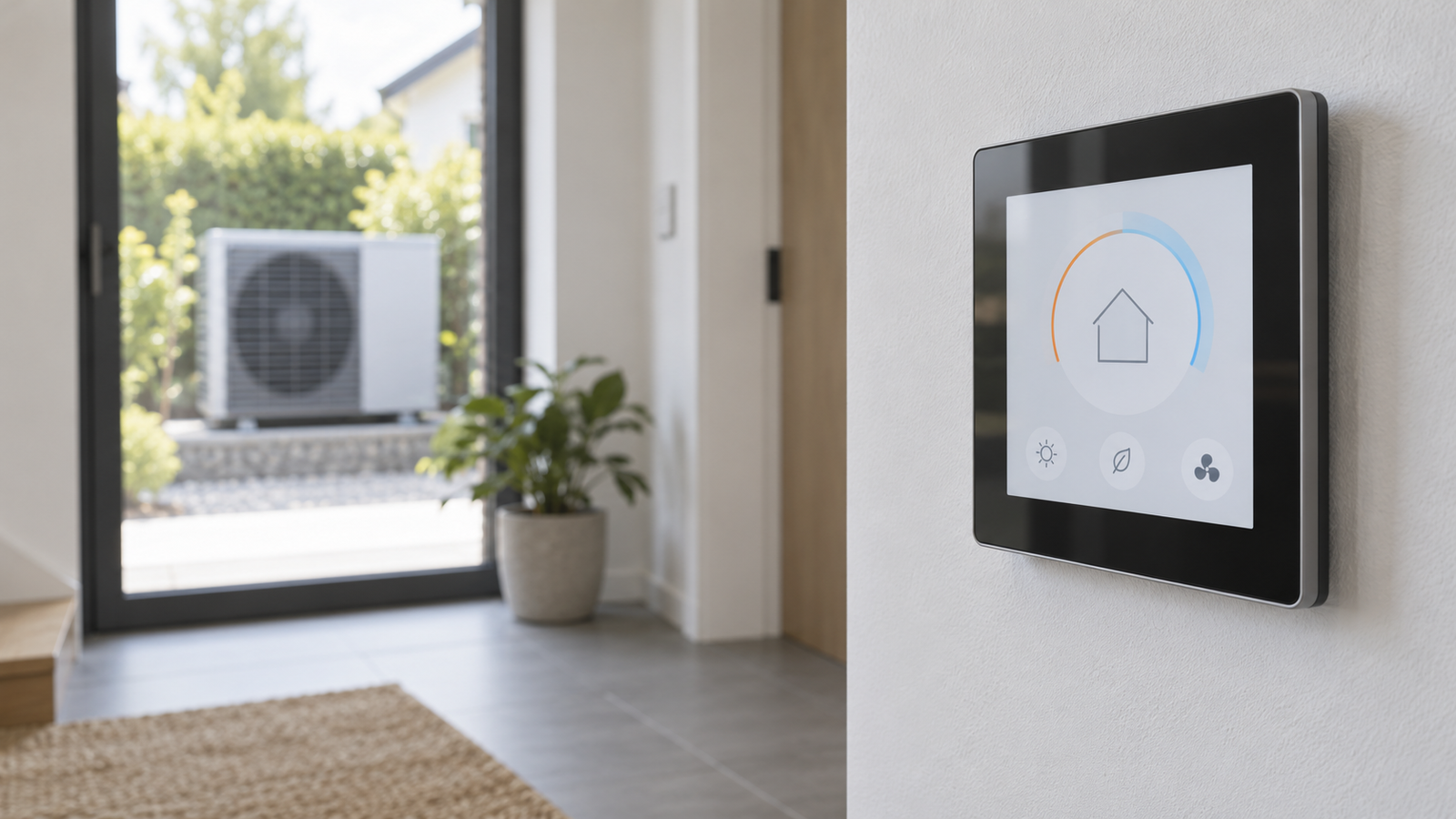
Two heat pumps can perform similar heating tasks while buying very different display hardware. One product may have a small equipment-mounted screen, another a wall controller, and a third a simplified local interface supported by an app. A stronger equipment market does not determine which configuration wins.
For heat pump OEMs and display suppliers, the commercial question is more specific: which operating, installation, and service tasks justify a local interface? The answer connects a market recovery to a feasible display program.
This article reviews European residential heat pump sales signals available in October 2026, then examines their implications for control interfaces. Published equipment figures are kept separate from qualitative analysis. No global heat pump display market value, screen attachment rate, or display-market CAGR is asserted.
1. Europe’s Heat Pump Recovery: What the Data Actually Shows
The European Heat Pump Association reports approximately 2.9 million heat pump sales across 21 European countries in 2025, with year-on-year growth of 13%. Its August 2026 explanation identifies these as domestic heat pumps.[1][3]
A newer release, dated September 28, 2026, reports about 1,163,000 residential heat pumps sold in the first half of 2026 across 12 countries. The corresponding first-half 2025 figure was about 1,048,000; EHPA reports growth of 11%.[2]
| Observation | Period | Coverage |
|---|---|---|
| Approximately 2.9 million sales; 13% reported growth | Full year 2025 versus 2024 | 21 European countries in EHPA’s published annual summary |
| Approximately 1.163 million sales; 11% reported growth | First half 2026 versus first half 2025 | 12 countries in EHPA’s September release |
The two observations support a recovery narrative within their respective coverage. They do not form a directly comparable Europe-wide growth sequence. The country sets and time periods differ, so the half-year figure should not be doubled to create a full-year forecast or compared with the annual total as though their populations matched.
EHPA’s August explanation places the recovery after sales declines in 2023 and 2024, and links improved demand to incentives and electricity taxation in several countries.[3] This is the association’s interpretation of equipment demand, not evidence that display spending rose by the same percentage.
The relevant commercial implication is to revisit customer programs. A recovering OEM may release a new controller, resume a delayed platform, or continue producing its existing design. Each action has a different consequence for display procurement.
The geographic scope also needs care. These are European country samples, not necessarily EU-only totals or a complete global market. Suppliers should map actual customers and production platforms rather than describe every regional inquiry as part of one uniform opportunity.
2. Heat Pump Sales Are Not Display Sales
A heat pump unit is not a display purchasing unit. The equipment architecture determines whether the system includes an integrated screen, a separate wall controller, several zone interfaces, or an alternative combination.
| Interface arrangement | Potential display role | Quantity question |
|---|---|---|
| Equipment-mounted control panel | Local status, configuration, and fault information. | Is it standard, optional, or limited to certain models? |
| Wall-mounted controller | Comfort settings and daily user interaction. | Is it bundled with the system or purchased separately? |
| Multiple-zone controls | Room or zone operation within the installation. | How many interfaces are allocated to each supported configuration? |
| Shared building control | Central oversight of several systems. | Does one interface serve multiple equipment units? |
| Simplified local controls plus app | Essential local actions with richer remote access. | Does the product use a TFT LCD, another display type, or indicators? |
These are possible architectures, not measured market shares. An OEM’s confirmed bill of materials and bundle structure provide the basis for a module forecast.
Distinguish the controller sold with a new installation from an optional accessory or replacement. A supplier can otherwise count the same interface twice: once inside the equipment forecast and again as a separate control product.
Replacement demand also requires evidence. Installed equipment does not become an immediate screen order. Service policy, compatibility, observed failures, and supported upgrades determine which assemblies may need replacement.
A display supplier should therefore ask for platform output, interface allocation, option uptake where known, and service requirements. Equipment-market growth establishes context; those project records establish accessible demand.
This distinction is particularly useful when comparing projects. A modest controller program with an approved assembly and repeat purchasing schedule can be more actionable than a large equipment forecast whose interface is still undecided.
3. Homeowners, Installers, and Technicians Need Different Interfaces
The same heating system serves several users. Their tasks should shape the local interface before the OEM selects its display size or touch configuration.
Homeowners: everyday comfort and understandable status
A homeowner may need to change a comfort setting, understand the current mode, or respond to an alert. The interface should make those tasks clear without exposing every engineering parameter as a routine control.
The commercial case for a richer screen should identify a specific benefit. Does it clarify schedules, distinguish modes, or help the user understand an interruption? These are hypotheses for product testing, not guaranteed reductions in support calls.
A simple interface may be appropriate if it covers the essential workflow. A premium screen has to justify its cost through useful presentation or interaction, rather than through resolution alone.
Installers: commissioning and configuration
An installer may need to identify the equipment configuration, check commissioning states, and confirm settings. Define which actions are performed locally and which require an approved service tool.

If one display serves both homeowners and installers, establish access boundaries and navigation. A larger screen can accommodate more information but cannot, by itself, prevent an inappropriate setting change.
Test the intended installation workflow with representative users. The evidence should show whether they can complete required steps and understand the result. That is more useful for display selection than a preference for a visually impressive menu.
Technicians: fault investigation and service
A technician needs enough information to choose the next investigation step. Product identity, configuration, and fault context can matter more than decorative graphics.
Define what remains available when remote services are unavailable. A local screen does not automatically provide offline diagnostics; that capability depends on the controller and software.
The resulting display brief should name the user, information, action, and permission for each important state. This turns a broad “smart heat pump” proposal into requirements that a supplier can review.
4. Local Controls, Mobile Apps, and Connected Home Platforms
Connected interfaces can complement local controls. The OEM must decide which channel owns each task and what fallback the product requires.
| Channel | Potential advantage | Issue to resolve |
|---|---|---|
| Local equipment display | Information beside the machine for setup and service. | Installation access, viewing conditions, and user permissions. |
| Wall controller | Daily interaction in a convenient occupied space. | Bundling, mounting, communication, and product variants. |
| Mobile app | Remote access and a larger personal interface. | Account access, supported devices, connection conditions, and handover. |
| Connected home platform | Coordination with other household systems. | Actual supported integration and responsibility for each function. |
An app can reduce the amount of information shown locally, but that does not establish that a screen is unnecessary. The local workflow may still need basic operation, status, or recovery information.
Conversely, a local display does not prove that a product can operate independently of its connected services. Specify the required behavior during account changes, communication interruptions, and service visits, then test the complete system.
For commercial planning, determine whether the same hardware supports several software tiers or whether each product tier has a separate controller assembly. These arrangements affect module quantities, qualification work, and spare management.
A round display may fit a compact wall control, while a rectangular display may suit more detailed menus. Format selection should follow the information task and enclosure. RJY’s round LCD selection guide discusses the associated integration questions.
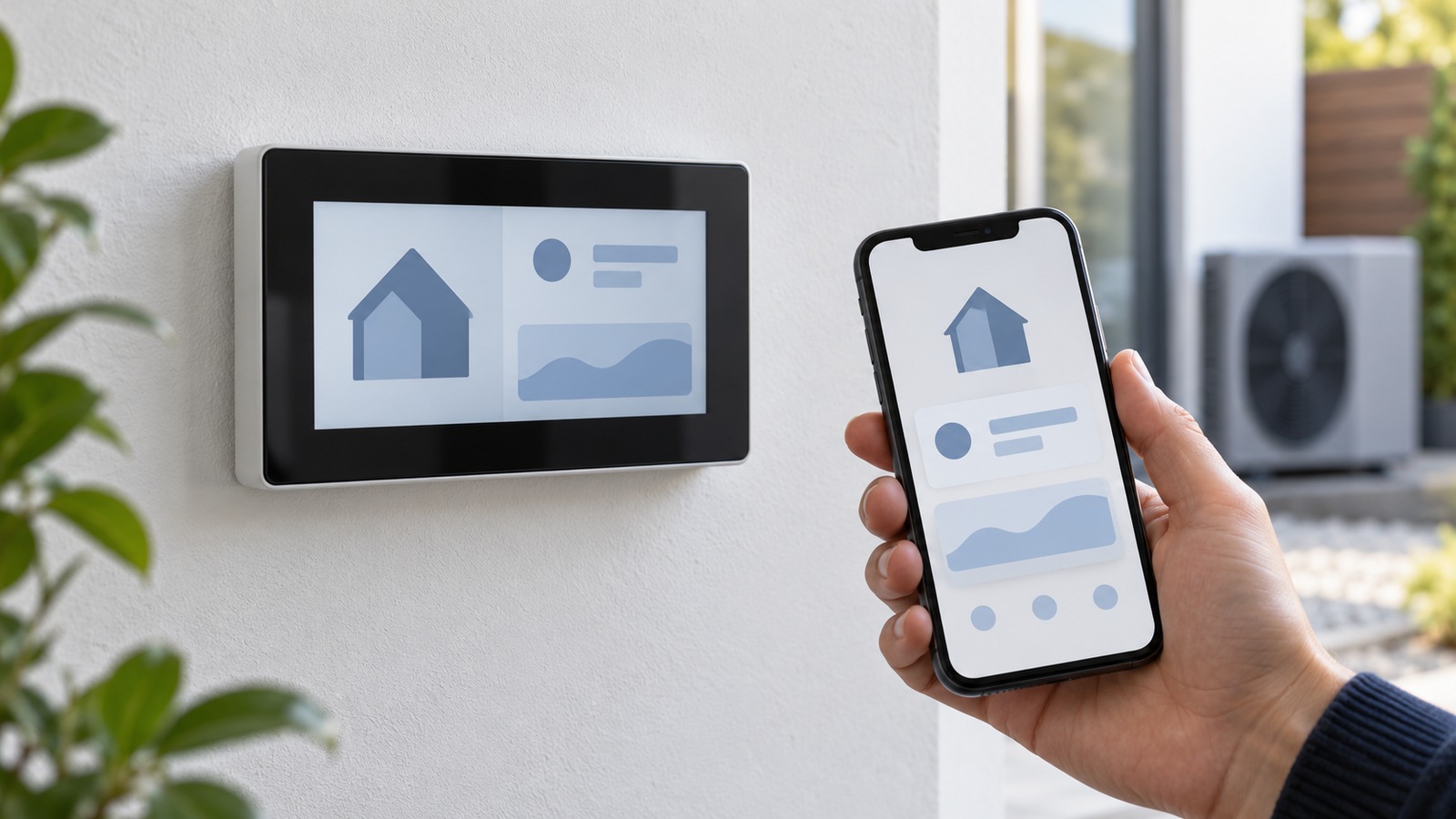
Analytical implication: connected-home adoption can change the local screen’s role without necessarily increasing or reducing its count. The direction depends on the selected architecture. Suppliers should track released configurations rather than assume that connectivity always means a larger touchscreen.
5. Where Display Customization Can Create Commercial Value
Customization is valuable when it solves a documented product constraint. It should begin with an existing module that fits the project, followed by a defined adaptation scope.
Cover, appearance, and mounting
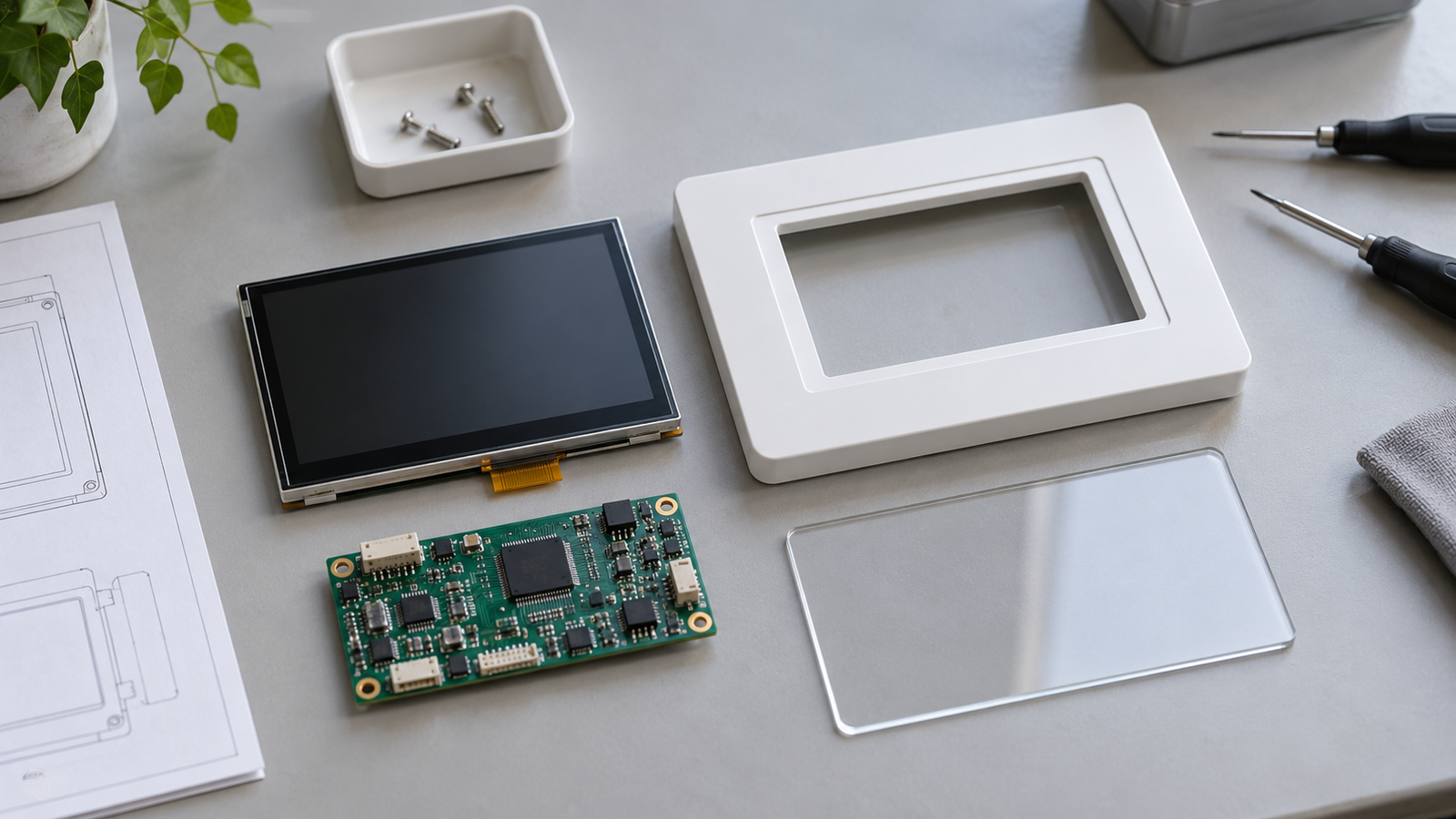
A wall controller may need a consistent appearance across regional or product variants. The visible window, border, cover, mounting, and enclosure depth should be reviewed together.
A common display core with different covers or mounting parts may be worth investigating. Feasibility depends on the module and assembly requirements; it is not a promise that any new panel size can be manufactured from scratch.
Input and software coordination
Touch, physical buttons, and rotary input represent different interaction choices. Decide which actions the product needs before specifying the input hardware.
For touch, confirm the cover stack, controller, host connection, coordinate mapping, and intended operation. For the image path, review the exact panel interface, timing, connector definition, power, and host software. An interface name alone does not establish compatibility.
Language versions introduce UI work as well as display requirements. Test representative translated screens, including longer messages and relevant characters. Do not confuse application localization with support for custom controller-board OSD menus.
Platform reuse and service
Sharing an assembly across models can reduce separate integration efforts when their requirements align. Compare viewing conditions, mechanical constraints, input needs, and service access before standardizing.
Maintain a clear record of the panel, touch, board, and firmware versions. A module substitution can require review even when its diagonal size and nominal resolution match.
The supplier opportunity lies in defined coordination and repeatable production. Claims that a more advanced display improves system efficiency require evidence from the complete heating product. The screen itself should not be credited with energy savings that have not been demonstrated.
6. Why Market Recovery Still Carries Procurement Risk
Growth in equipment sales is a positive signal, but it does not eliminate uncertainty in a display program. Suppliers should distinguish regional demand, OEM output, channel activity, and released component orders.
EHPA’s account of the recovery emphasizes policy support and operating economics.[3] That makes policy and energy-cost changes relevant monitoring questions. It does not justify attributing every customer order change to one cause.
- Policy exposure: identify which customer programs depend on particular market conditions or support mechanisms.
- Channel inventory: ask whether production forecasts reflect end demand, replenishment, or stock adjustment. This is a project risk to investigate, not a quantified claim about current inventory.
- Controller redesign: an OEM may simplify the local interface or move functions to another channel.
- Qualification timing: display, touch, enclosure, and software work can postpone a release even when the equipment market improves.
- Customer concentration: several discussions may depend on one platform or production program.
- Lifecycle cost: a low module price can lose its advantage if integration or replacement is difficult.
Track these factors at the opportunity level. A forecast, a validated sample, and a scheduled purchase are different kinds of evidence. Combining them into one demand number makes the pipeline look more certain than it is.
Keep optional configurations separate. A touchscreen proposed for a premium tier should not be counted across the entire equipment range until the allocation is confirmed.
7. An OEM Framework for Evaluating a Display Program
Start with the product configuration and its user tasks. Then test whether the display program is commercially repeatable and technically feasible.
| Decision | Evidence needed | Commercial relevance |
|---|---|---|
| Interface role | Daily operation, commissioning, and service tasks by user. | Justifies local hardware and its scope. |
| Hardware allocation | Displays per platform, bundled controls, and optional accessories. | Prevents double counting. |
| Integration boundary | Panel, touch, host, enclosure, and software responsibilities. | Defines the work behind the quotation. |
| Platform reuse | Shared requirements and differences across variants. | Identifies realistic common-assembly opportunities. |
| Production readiness | Validation milestones and purchasing schedule. | Separates an idea from a released program. |
| Service plan | Replacement procedure, version control, and justified spare allocation. | Supports lifecycle cost comparison. |
Construct quantity scenarios from those records. A lower case might include a delayed release or fewer display-equipped variants. A higher case might include additional approved platforms. Label each assumption and revise it when the architecture or purchasing plan changes.
Compare equivalent quotation scopes. A bare TFT LCD, a touch-and-cover assembly, a display with an active controller, and a complete control terminal are different products. The lowest quoted number is not necessarily the lowest cost for the required function.
For validation, use the intended enclosure, host software, and representative screens. Check ordinary tasks and fault states, not only whether the display lights up on a bench. RJY’s LCD image retention guide provides additional context for evaluating persistent interface content.
The practical outlook is selective. Wall controls with a clear daily-use role and equipment interfaces with useful commissioning or service functions are reasonable opportunities to investigate. This is a qualitative priority framework, not a measured ranking of display revenue.
A market recovery becomes an actionable module program when the OEM can connect useful interaction, validated integration, and a credible production plan. Those links should guide investment before the display specification becomes fixed.
8. FAQ
Can European heat pump sales growth be used as display-market growth?
No. Equipment sales do not specify display quantities, optional wall controls, shared interfaces, or replacement demand. Display forecasts require platform-specific information.
Are EHPA’s 2025 annual figures directly comparable with its first-half 2026 figures?
Not as one continuous market total. The cited annual summary covers 21 countries, while the half-year release covers 12. Their periods and geographic coverage must remain explicit.
Does every heat pump need a TFT touchscreen?
No. The appropriate interface depends on daily use, commissioning, service, and the product architecture. Some designs can use simpler displays, physical controls, apps, or shared interfaces.
Does a more advanced display prove better heat pump energy efficiency?
No. A display can present information and support interaction, but energy-performance claims require evidence from the complete heating system and its operation.
What should an OEM provide for a heat pump display proposal?
Provide the interface users and tasks, hardware allocation, panel and host requirements, input needs, enclosure constraints, software scope, production plan, validation requirements, and service expectations.
Discuss Your Heat Pump Control Interface with RJY
RJY Display supports TFT LCD modules, controller-board adaptation, and customization based on existing modules, including touch, cover glass, firmware, and mechanical coordination according to feasibility. Share your heat pump display requirements with the intended interface role, host, enclosure, operating conditions, and expected production. Compatibility and customization scope require project-specific review.
References
Sources reviewed on October 14, 2026. EHPA figures describe residential equipment sales within the stated coverage. Interface comparisons and procurement frameworks are qualitative analysis, not observed display-market statistics.
- European Heat Pump Association: Market Data, 2025 annual summary.
- EHPA: Post-Hormuz Heat Pump Sales Climb 11%, September 28, 2026. First-half figures cover Austria, Belgium, Switzerland, Denmark, Finland, France, Germany, Italy, the Netherlands, Norway, Portugal, and Sweden.
- EHPA: Why Heat Pump Sales Are Growing Again, August 6, 2026.