

In the field of optoelectronics, a display is a sophisticated multi-layered system where the Touch Panel (TP) must be precisely harmonized with the TFT-LCD or AMOLED module. The choice between G+G, G+F, and G+FF architectures determines not only the physical durability of the device but also its signal-to-noise ratio, optical transmittance, and compatibility with specific TFT backplanes.
When suppliers ask if you need G+G, G+F, or G+FF technology, you may not fully understand the differences or know which one fits your needs. Here’s a brief overview to help you decide.
The Architectural Hierarchy
Understanding these technologies requires analyzing the complete LCD Module (LCM) stack from the light source to the user interface:
- Backlight Unit (BLU): Typically an LED array providing the initial luminance (Nits).
- TFT Substrate: The glass backplane containing the Active Matrix (a-Si, LTPS, or IGZO) and the Pixel Circuits.
- Liquid Crystal Layer: Modulated by the TFT electrodes to control light passage.
- Color Filter (CF) & Front Polarizer: Establishing the chromatic output.
- Touch Panel (TP) Layer: The sensing stage where G+G, G+F, or G+FF stacks are implemented.
- Cover Glass (CG): The final chemically-strengthened protective layer.
Basics of G+G, G+F, and G+FF
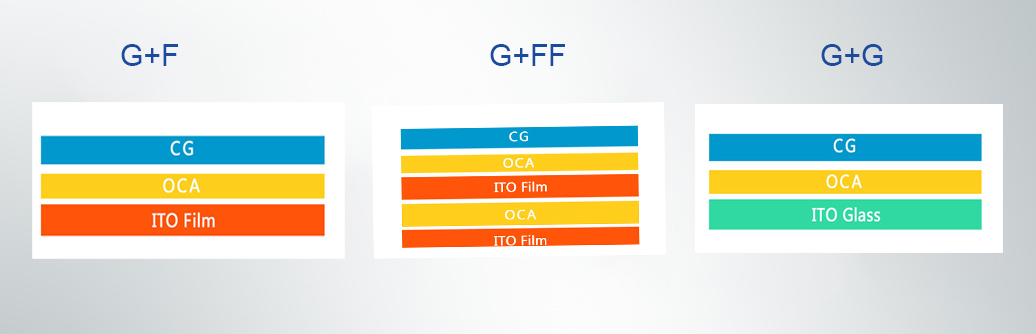
LCD screens consist of three parts: the cover glass (CG), the touch panel (TP), and the display screen. G+G, G+F, and G+FF technologies are applied at the TP layer.
- G+G (Glass-Glass): CG + ITO Glass
- G+F (Glass-Film): CG + ITO Film
- G+FF (Glass-Film-Film): CG + ITO Film + ITO Film
1. GG Technology (Glass-Glass)
G+G is the high-fidelity standard for industrial and medical TFT-LCD applications. By using a rigid glass substrate for the Indium Tin Oxide (ITO) sensing layer, it ensures maximum mechanical stability.
- TFT Synergy: Glass sensors are thermally stable, maintaining alignment with the TFT pixel grid even under high-temperature operation. This prevents Moiré patterns and “shimmering” effects.
- High Transmittance: Glass offers superior optical clarity, ensuring that the TFT’s peak brightness reaches the user with minimal attenuation.
- Active Matrix Protection: The rigid double-glass structure provides a physical buffer, protecting the fragile TFT transistors and Gate/Source Drivers from localized pressure.
- Limitations: Increased weight and thickness compared to film-based solutions, and a higher susceptibility to shattering under extreme mechanical shock.
However, its heavier weight and higher fragility make it less suited for devices requiring special shapes.
2. GF Technology (Glass-Film)
G+F is a cost-engineered architecture, frequently paired with Amorphous Silicon (a-Si) TFT modules for entry-level or weight-sensitive applications.
- Thin Profile: Replacing a glass layer with an ITO PET film reduces the overall LCM thickness and weight.
- Cost Efficiency: Film processing is generally less capital-intensive than glass-based vacuum deposition, lowering the Unit Economics of the display.
- Technical Constraints: G+F is often limited to Passive Matrix or single-touch scanning. Because film has lower electrical conductivity than glass, its anti-interference (EMI) capabilities are reduced, making it sensitive to noise generated by the TFT Driver IC.
While more flexible, G+F touchscreens are less durable, less scratch-resistant, and typically limited to single-touch functionality. and its anti-interference ability is not good. Moreover, it is mainly single point and does not support multi-touch.
3. GFF Technology (Glass-Film-Film)
G+FF is a versatile, high-performance architecture that utilizes two distinct film layers (X and Y axis) to enable sophisticated interaction.
- Multi-Touch & Gesture Support: This dual-layer approach allows for 10-point multi-touch and high-speed stylus handwriting, matching the high refresh rates (60Hz–120Hz) of modern LTPS (Low-Temperature Polycrystalline Silicon) TFTs.
- Enhanced Anti-Interference: High-resolution TFT screens generate significant electromagnetic noise from their high-speed Gate and Source lines. G+FF provides superior signal isolation, ensuring touch accuracy even in electrically noisy industrial environments.
- Flexibility: The PET-based sensor can be cut into complex shapes or bonded to Curved TFT panels, offering a level of design freedom that rigid glass cannot provide.
However, G+FF may have slightly reduced optical clarity and lower durability compared to G+G.
TFT Backplane & Touch Sensing Compatibility
Selecting a touch architecture requires alignment with the specific TFT substrate type:
| TFT Backplane | Recommended TP | Technical Rationale |
| a-Si (Amorphous Silicon) | G+F / G+FF | Cost-effective pairing for standard industrial HMI. |
| LTPS (Poly-Si) | G+FF / In-Cell | Matches the high electron mobility and fast refresh cycles of LTPS. |
| IGZO (Metal Oxide) | G+G / G+FF | Supports ultra-high resolution 4K/8K TFT with high touch sensitivity. |
| AMOLED (Active Matrix OLED) | G+FF / On-Cell | Requires thin, flexible sensors to preserve the OLED’s thin form factor. |
Strategic Selection by Application
Industrial & Medical Control Systems
- Configuration: G+G paired with IGZO TFT.
- Rationale: Prioritizes optical clarity and thermal stability. The IGZO backplane allows for high-resolution static images with low power, while the G+G sensor ensures 24/7 durability in sterile or harsh environments.
Professional Design & High-End POS
- Configuration: G+FF paired with LTPS TFT.
- Rationale: LTPS offers the highest performance for fluid UI transitions. G+FF provides the multi-touch capabilities and high signal-to-noise ratio required for professional accuracy.
Portable Field Sensors & Consumer Entry-Level
- Configuration: G+F paired with a-Si TFT.
- Rationale: Focused on weight reduction and cost management while providing reliable single-touch functionality for basic data entry.
Summary of Technical Parameters
When evaluating a display module, engineers should consider the Integrated System performance. While In-Cell and On-Cell touch (where sensors are embedded directly into the TFT layers) are gaining traction for mass-market mobile devices, discrete G+G and G+FF architectures remain the standard for specialized industrial applications that require custom cover glass, specific EMI shielding, or high-impact resistance.