
The Semantic Clarification: IPS is a TFT
Before diving into the specifications, we must address a fundamental industry misconception. IPS is not an alternative to TFT; it is a specific type of TFT LCD. TFT refers to the active matrix architecture where each pixel is controlled by an individual transistor. When manufacturers or suppliers pitch “TFT vs. IPS,” they are usually comparing a basic TN (Twisted Nematic) TFT panel against a premium IPS TFT panel. For the sake of industry convention, this article will use “Standard TFT” to refer to basic TN/VA panels and “IPS” to refer to In-Plane Switching panels.
What is a Standard TFT LCD?
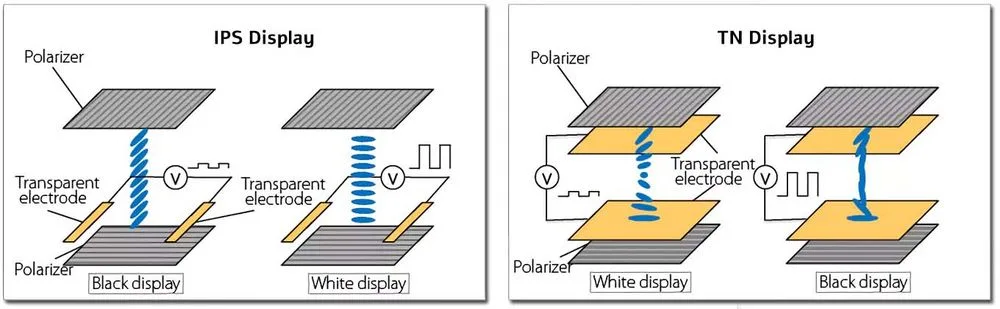
A standard TFT LCD relies on liquid crystals that naturally align vertically or twist between glass substrates. When an electrical current is applied, these crystals untwist to allow the backlight to pass through the colour filters.
Key Characteristics:
- Cost-Efficiency: Standard TFT manufacturing is highly mature, making it the most cost-effective active-matrix display available.
- Rapid Response Times: The twisting mechanism of the crystals is exceptionally fast, which was historically highly valued for basic video playback and legacy gaming.
- The Drawback (Viewing Angles): Because the crystals align vertically, light is projected forward in a narrow cone. If you view the screen from a side angle, the light passes through the crystals unevenly, causing severe colour inversion and contrast degradation.
What is an IPS Display?
Developed specifically to solve the viewing angle and colour reproduction limitations of early TFT screens, In-Plane Switching (IPS) completely alters the physical orientation of the liquid crystals. Instead of standing vertically, the crystals are aligned horizontally (in-plane) parallel to the glass substrates.
Key Characteristics:
- Superior Viewing Angles: Because the crystals rotate horizontally, light is scattered evenly in all directions. This guarantees that colours and contrast remain stable even at extreme 178° viewing angles.
- High Colour Fidelity: IPS panels provide true-to-life colour reproduction, supporting wider colour gamuts necessary for professional applications.
- The Drawback (Power & Cost): Driving the crystals horizontally requires two transistors per pixel instead of one, and the structural design blocks slightly more of the backlight. Consequently, IPS panels are more expensive to produce and typically consume slightly more power to achieve the same brightness levels.
Direct Technical Comparison
To assist in specification and procurement, the following table highlights the practical differences between Standard TFT and IPS displays:
| Feature | Standard TFT (TN/VA) | IPS Display |
| Crystal Alignment | Vertical / Twisted | Horizontal (In-Plane) |
| Viewing Angles | Narrow (colours shift off-axis) | Ultra-wide (consistent up to 178°) |
| Colour Accuracy | Moderate | Excellent (Reference-grade) |
| Response Time | Ultra-fast (<1ms to 5ms) | Fast (Modern IPS panels achieve 1ms to 5ms) |
| Power Consumption | Lower (highly efficient) | Slightly higher (requires a stronger backlight) |
| Production Cost | Low | Moderate to High |
Strategic Applications by Industry
Choosing the right panel depends heavily on the end-user environment and the critical requirements of the project.
When to Specify Standard TFT Displays:
- Industrial and Telemetry Equipment: Factory control panels (HMIs) and CNC machine interfaces where the operator stands directly in front of the screen.
- Automotive Clusters: Basic dashboard metrics where the viewing angle is fixed relative to the driver.
- Budget Consumer Electronics: Entry-level smart home hubs, basic white goods (washing machine displays), and budget mobile phones where BOM (Bill of Materials) cost is the driving factor.
When to Specify IPS Displays:
- Medical Imaging: Essential for diagnostic equipment (ultrasounds, patient monitors) complying with strict European medical directives, where accurate colour reproduction can impact diagnostics.
- Professional Workstations: Graphic design monitors, video editing suites, and CAD engineering displays.
- Collaborative Environments: Point of Sale (POS) systems, interactive kiosks, and premium automotive infotainment systems that must be clearly visible to both the driver and the passenger.
Conclusion
The debate between TFT and IPS is not a matter of one being universally superior, but rather a calculation of application requirements. If your project demands strict cost control, simplicity, and low power consumption for direct-viewing applications, standard TFT LCDs remain an incredibly reliable choice. However, if visual accuracy, premium user experience, and off-axis readability are paramount, investing in IPS technology is the clear, professional standard.
Frequently Asked Questions (FAQ)
Q: Why do some spec sheets list both “TFT” and “IPS” for the same screen?
A: This is technically the most accurate way to describe the screen. It signifies that the display uses an Active Matrix (TFT) backplane driving In-Plane Switching (IPS) liquid crystals.
Q: Does an IPS display consume significantly more battery on a portable device?
A: Historically, yes. Because the electrode arrangement in an IPS panel blocks slightly more light, the LED backlight must be driven harder to achieve the same luminance (nits). However, modern advancements in backlight efficiency have made this difference negligible for most standard use cases.
Q: Are standard TFTs better for outdoor, sunlight-readable applications?
A: Standard TFTs generally allow more light to pass through, making it slightly easier and cheaper to achieve ultra-high brightness (e.g., 1000+ nits). However, premium IPS panels are frequently used outdoors today due to advanced optical bonding and anti-glare treatments.
Reference Resources
- Society for Information Display (SID): Comprehensive academic and industry research on display mechanics. (sid.org)
- IEEE Xplore Digital Library: Peer-reviewed papers on the evolution of active-matrix liquid crystal displays and in-plane switching efficiencies. (ieeexplore.ieee.org)
- DisplayMate Technologies: Scientific, laboratory-based evaluations and comparisons of display technologies, colour accuracy, and viewing angles.