
1. Defining the Architecture: What Happens Behind the Glass?
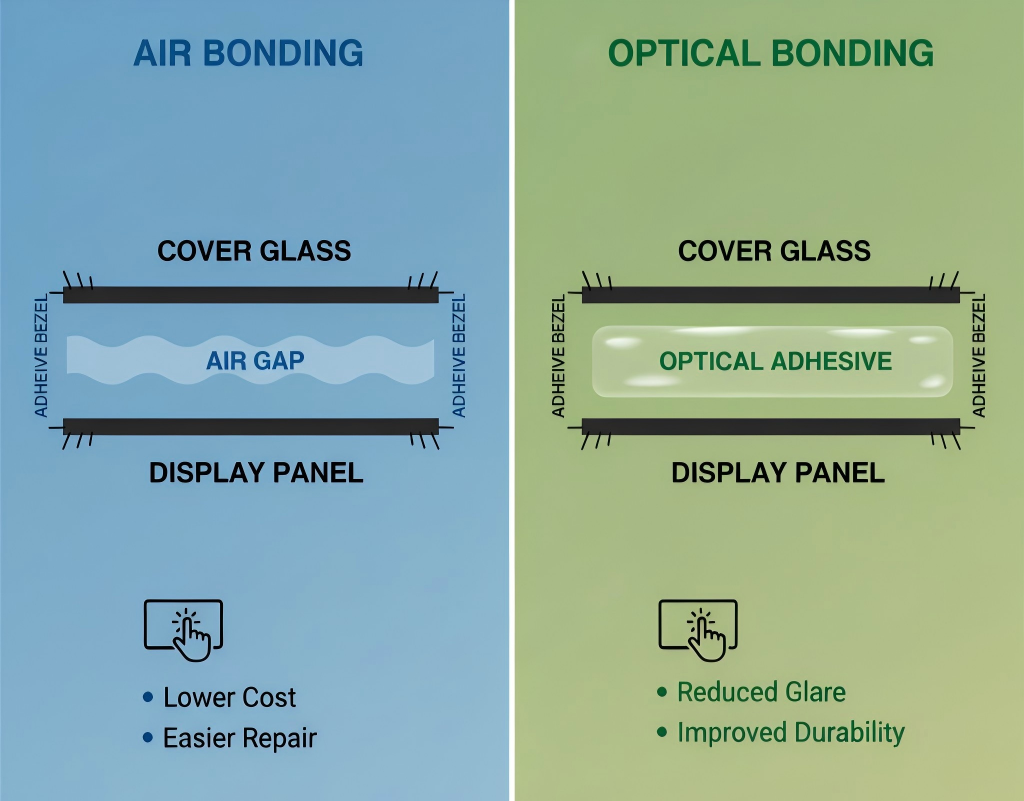
To understand the difference, we must look at the cross-section of a modern touch panel assembly.
1.1 Air Bonding (Frame Bonding)
Air Bonding, often referred to as “perimeter bonding,” is the more traditional approach. In this method, the touch screen and the LCD module are attached using double-sided adhesive tape along the edges (the frame).
- The Structure: This creates a microscopic air gap between the touch sensor and the display surface.
- The Technical Challenge: This air gap creates two extra reflective surfaces. When light passes through the cover glass, into the air, and onto the LCD, it refracts at each interface, leading to significant light loss and internal reflections.
1.2 Optical Bonding (Full Bonding)
Optical Bonding is an advanced process where a specialized, medical-grade adhesive—either Liquid Optically Clear Resin (LOCA) or Optically Clear Adhesive (OCA) film—is used to fill the entire space between the touch panel and the display.
- The Structure: By filling the air gap with a material that has a refractive index nearly identical to glass, we effectively create a single, solid optical block.
- The Result: Light passes through the layers without refraction, resulting in a display that is remarkably clear and vibrant.
2. Visual Performance: The Battle for Clarity
For any lcd touch panel intended for high-ambient light or outdoor environments, visual performance is the primary differentiator.
2.1 Contrast and Brightness
In Air Bonding, the air gap reflects a significant portion of the display’s backlight back into the device, while ambient light from the outside reflects off the internal surfaces. This “washout” effect drastically reduces the contrast ratio.
Optical Bonding eliminates these internal reflections. For a device used in direct sunlight, such as a smart retail kiosk or an EV charging station, an optically bonded touch screen can appear up to 3x brighter and much sharper than an air-bonded one with the same backlight intensity.
2.2 Parallax Errors
Have you ever touched a screen and felt like the cursor was a few millimeters away from your fingertip? This is known as a parallax error, caused by the physical distance of the air gap. In high-precision applications—like robotic surgery or industrial CAD stations—this gap can lead to input errors. Optical Bonding brings the display image directly to the surface, providing a more intuitive and accurate “pen-on-paper” feel.
3. Ruggedness and Environmental Reliability
At RJY, we emphasize industrial-grade quality, and this is where Optical Bonding truly shines as a protective measure.
3.1 Condensation and Dust
Air gaps are susceptible to “breathing.” As temperatures fluctuate, moist air can be drawn into the gap, leading to internal condensation or “fogging” that is impossible for the user to wipe away. Furthermore, over time, fine dust particles can migrate into the frame and settle on the LCD.
Optical Bonding completely seals the unit. It is the gold standard for medical equipment and industrial IoT devices that must operate in humid, dusty, or unconditioned environments.
3.2 Impact and Vibration Resistance
A solid, bonded display is physically stronger. The adhesive layer acts as a shock absorber, distributing the force of an impact across the entire surface of the lcd touch panel rather than concentrating it on the glass edges. This is a critical factor for handheld devices or systems mounted on heavy machinery that experience constant vibration.
4. The Engineering Trade-offs: Cost, Rework, and Complexity
If Optical Bonding is superior in performance, why is Air Bonding still widely used? The answer lies in the manufacturing complexity.
4.1 Cost Considerations
Air Bonding is simpler, faster, and requires less specialized equipment, making it the go-to choice for cost-sensitive projects where the device will stay in a controlled, indoor environment (like a basic POS terminal).
4.2 Reworkability
If a speck of dust is caught during the Air Bonding process, the parts can usually be separated and cleaned easily. Optical Bonding, particularly with LOCA, is much more permanent. Reworking a failed bond is a complex, delicate, and sometimes impossible task, which contributes to higher production risks and costs. This is why partnering with an agile, experienced manufacturer like RJY is essential to maintain high yields and quality standards.
5. Application Guide: Which One is Right for You?
To simplify your selection process, we have categorized the preferred bonding methods by target market:
| Industry Segment | Preferred Method | Key Reasoning |
| Medical Equipment | Optical Bonding | Zero fogging, easy to sanitize, high precision. |
| Industrial Robotics | Optical Bonding | Vibration resistance and high-impact durability. |
| Smart Retail (Indoor) | Air Bonding | Cost-effective for standard indoor lighting. |
| Transportation/EV | Optical Bonding | Sunlight readability and wide temperature stability. |
| Industrial IoT | Depends on Env. | Air bonding for cabinets; Optical for handhelds. |
6. How RJY Elevates Your Display Integration
As a full-cycle innovation hardware provider, RJY doesn’t just offer a choice; we offer an optimized system. We understand that your touch panel is the face of your brand.
- Deep Customization: We assist in selecting the right adhesive (OCA vs. LOCA) based on your specific mechanical housing and cover glass thickness.
- Software Synergy: Our Software Services team ensures that the touch controller’s sensitivity is tuned to match the bonding method, ensuring that the “hand-feel” is consistent and responsive.
- Certification Ready: Every bonded unit undergoes rigorous thermal cycling and vibration testing to ensure it meets the certifications required for your specific market.
Conclusion: Bridging the Gap to Success
The choice between Air Bonding and Optical Bonding is a fundamental engineering decision that dictates the lifespan and usability of your product. While Air Bonding offers a low-cost entry point for controlled environments, Optical Bonding provides the visual clarity, physical toughness, and environmental resilience required for high-performance applications.
By understanding these technical distinctions, you can better align your hardware strategy with your users’ needs. At RJY, we are committed to helping you bridge the gap between concept and reality, providing the expertise in touch screen integration that ensures your innovation stands out in any light.
Ready to enhance your display’s performance?
Contact RJY today to discuss your project requirements. Whether you need a cost-effective air-bonded solution or a high-end optically bonded system, our engineers are here to provide the “Shenzhen Agility” and industrial quality your brand deserves.