
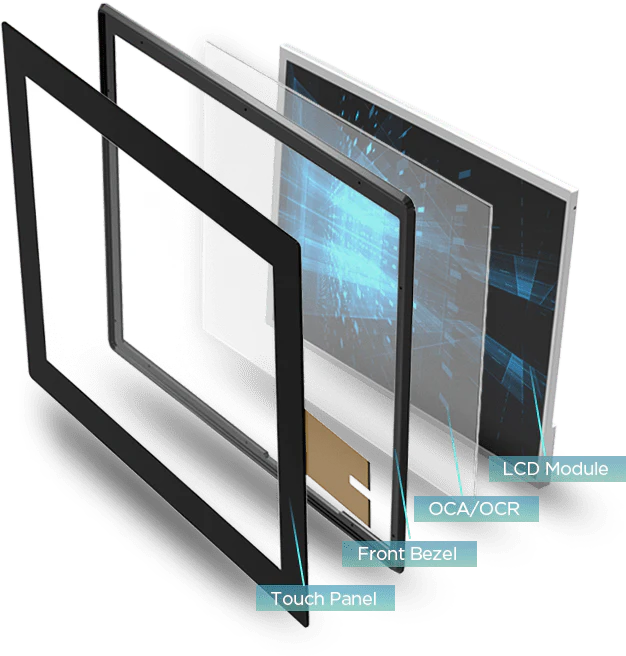
1. Decoding the Core Technology: PCAP vs. Resistive
Before diving into specific applications, one must understand the two dominant technologies that command the touch panel market.
1.1 Projective Capacitive (PCAP) Touch Panels
The PCAP touch screen is the gold standard for modern electronics. It works by detecting the change in electrical capacitance when a conductive object (like a finger) approaches the surface.
- The Advantage: It supports multi-touch (up to 10 points or more), offers high transparency (over 90%), and allows for a “flush-surface” design with a cover glass that can be hardened for durability.
- The RJY Perspective: For our Systems & HMI sector, PCAP is our primary choice for smart retail and medical equipment because of its sleek aesthetics and long-term reliability against wear and tear.
1.2 Resistive Touch Panels
Though often considered “legacy,” the resistive lcd touch panel remains vital in specific industrial niches. It relies on physical pressure to connect two conductive layers.
- The Advantage: It is immune to electromagnetic interference (EMI) and can be operated with any object—stylus, gloved hand, or even a tool.
- The Trade-off: It is prone to scratches and has lower optical clarity compared to capacitive options.
2. Environmental Stressors: Why Location Changes Everything
Where your device lives determines the touch panel it needs. At RJY, we focus on Industrial-grade quality, which means designing for the “worst-case scenario.”
2.1 Outdoor Readability and Sunlight
If you are designing a smart charging station or a transportation kiosk, sunlight is your enemy. A standard lcd touch panel creates internal reflections that wash out the image.
- Optical Bonding: This is a critical process where a vacuum-grade resin is used to bond the touch screen directly to the LCD. By removing the air gap, we reduce reflections by up to 90% and prevent internal condensation (fogging).
- High-Brightness Integration: To counteract ambient light, we often pair our Display Modules with high-nit backlights (1000+ nits) and specialized AR (Anti-Reflective) coatings on the touch panel.
2.2 Temperature Extremes and Humidity
In the Industrial IoT and Transportation sectors, devices must survive from -20°C to +70°C. High humidity can cause “ghost touches” on standard capacitive screens. Selecting a touch panel with an industrial-grade controller (such as those from ILITEK or EETI) allows for firmware tuning that ignores environmental moisture while maintaining high sensitivity.
3. The User Interface (UI) and Operational Constraints
Selection is not just about the “where,” but the “who” and “how.”
3.1 Glove and Water-Drop Support
In a medical setting, a surgeon cannot remove their gloves to adjust a monitor. In a kitchen (smart cooking robots), the screen will inevitably be splashed with water.
- Firmware Customization: As a full-cycle innovation provider, RJY doesn’t just sell hardware. We provide Software Services to tune the touch controller’s firmware, enabling “Glove Mode” or “Water-Rejection Mode.” This ensures the touch screen only responds to intentional commands.
3.2 Impact Resistance and Safety
For public-facing kiosks (Smart Retail), the touch panel must double as a shield. The selection of the Cover Lens (the outermost glass layer) is crucial. We offer tempered glass with varying thicknesses (up to 6mm or more) and IK10 impact ratings to ensure the system remains functional even under physical abuse.
4. Deep Integration: The “Computing + Display” Synergy
This is where RJY’s core advantage—Deep Integration—comes into play. A touch panel is useless without a “brain” to interpret the signals.
4.1 Driver and BSP Optimization
Many OEMs struggle with the latency between a touch event and the system’s response. By integrating our High-Performance Computing modules with the lcd touch panel, we optimize the Board Support Package (BSP) at the kernel level. This reduces touch-to-display latency, creating a seamless, “zero-lag” user experience that is critical for precision medical or robotic controls.
4.2 EMI Shielding in Industrial Environments
Large motors and heavy machinery generate massive electromagnetic noise. A cheap touch panel will fail in these environments. We implement specialized shielding and ground-loop designs within our Systems & HMI solutions to ensure that the electrical noise of the machine doesn’t interfere with the delicate signals of the touch sensor.
5. Customization: Beyond the Standard Sheet
In the high-tech market, “standard” is rarely enough. Our Shenzhen Agility allows us to offer:
- Unique Shapes: Round touch panels for wearable medical devices or bar-type screens for industrial shelving.
- Custom Printing: Adding your brand logo, physical buttons, or specialized icons directly onto the cover glass of the touch screen.
- Integrated Peripherals: Building cameras, RFID readers, or microphones directly into the touch panel assembly for a truly “all-in-one” solution.
6. Manufacturing and Certification: The Final Mile
A product is only as good as its certifications. As a full-cycle innovation hardware provider, RJY ensures that every lcd touch panel assembly is ready for the real world.
- Reliability Testing: We conduct salt spray tests, thermal cycling, and ESD (Electrostatic Discharge) testing to ensure the touch panel survives years of operation.
- Global Compliance: We assist in obtaining necessary certifications (CE, FCC, RoHS) by ensuring the display and computing components are designed for compliance from day one.
Conclusion: Making the Right Choice
Adding touch to a display module is an evolution of your product’s value proposition. The selection of a touch panel is a multi-dimensional decision that impacts cost, durability, and user satisfaction. By understanding the technological differences between PCAP and resistive tech, and considering the environmental and operational stressors, you can choose a solution that stands the test of time.
At RJY, our mission is to simplify this complexity. We combine our expertise in Display Modules, High-Performance Computing, and Software Services to deliver a fully integrated, certified, and customized solution that brings your vision to life.